Chapter 20: Getting Started with MCP in Claude Code
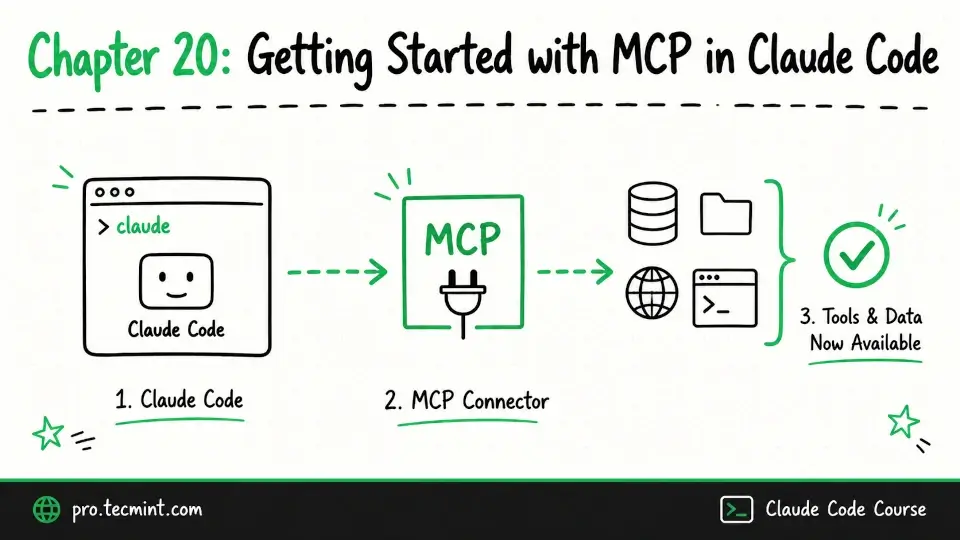
In this chapter, you'll learn what the Model Context Protocol is, how it connects Claude Code to your existing tools, and why it matters for sysadmin work specifically.
In the previous chapter, we finished Module 5 by creating three practical Skills for disk audits, backup verification, and log analysis.
Those Skills help you automate repetitive tasks so you can use them again whenever you need them.
In Module 6, we'll take the next step by connecting Claude Code to the tools you already use.
Instead of working only with files and shell commands, Claude Code will be able to read live data directly from those tools.
In this chapter, you'll learn about MCP (Model Context Protocol), the open standard that makes these connections possible.
This is a conceptual chapter, so you won't be setting anything up yet. By the end, you'll understand what MCP is, how it's different from what we've covered so far, what its three core primitives are, and which MCP servers are most useful for Linux system administrators.
In the next three chapters, we'll connect real MCP servers and use them in practical examples.