Chapter 1: Introduction to Ubuntu
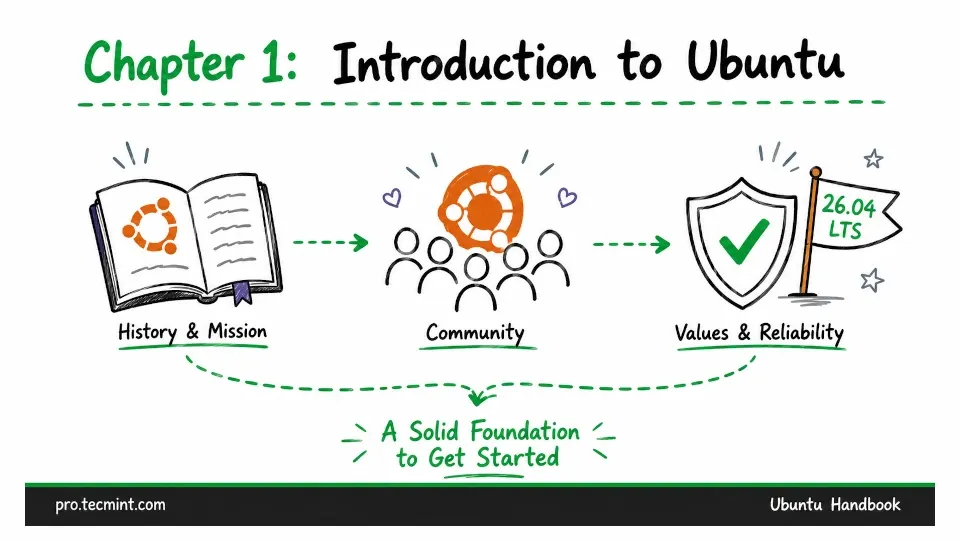
In this chapter, we introduce Ubuntu 26.04 LTS, covering its history, mission, releases, community, and values to help beginners get started.
Whether you've been using Linux for years or you're installing it for the first time, this series will guide you through Ubuntu from the ground up.
We'll start by understanding what Ubuntu actually is, then gradually build it into a complete development environment.
But before we talk about Ubuntu, let's first understand Linux.
Linux is an operating system, just like Windows or macOS. It belongs to the same category, but it works differently behind the scenes and was designed with a different set of goals.
You've probably used Linux without even realizing it. Android is built on Linux, and most of the servers that power the internet also run Linux.
Now here's one point that often confuses beginners. Technically, the word Linux refers only to the kernel. The kernel is the core part of the operating system that communicates with your hardware and manages the system underneath everything else.
By itself, though, the kernel isn't something you can install and use as a complete operating system. It needs applications, utilities, and system services around it. A Linux distribution brings all of these pieces together into a complete, installable operating system.
Ubuntu is one such Linux distribution. Fedora, Debian, Arch, and many others are also Linux distributions, each with its own approach to building and managing a Linux system.
So when people say, "I use Linux," they're almost always referring to a particular Linux distribution, not the Linux kernel itself.
There are dozens of active Linux distributions available today, and each one is designed with a different goal or audience in mind. Some focus on simplicity, others on performance, security, or customization.
Most of them also include sensible default applications and settings, making it easier for people moving from Windows or macOS to get started without having to build everything from scratch.
In this series, we'll be using Ubuntu, one of the most beginner-friendly and widely used Linux distributions.
We'll work with the latest Long Term Support (LTS) release, Ubuntu 26.04, which is designed to provide a stable and reliable platform for both everyday use and development.
In this chapter, we'll cover the following topics:
- A brief history of Ubuntu and what it is.
- An introduction to free software and the open-source world.
- Ubuntu's community and support resources.