Chapter 9: Basics of Network IP Addressing
In this chapter, you'll learn what IP addresses are, how IPv4 and IPv6 work, what subnet masks are, how CIDR notation works, and how to identify network addresses in Linux.
In Chapter 8 of the LFCA Certification Course, you learned how to read CPU, memory, disk I/O, and network traffic data using vmstat, mpstat, iostat, and sar, and those tools gave you a picture of what a Linux system is doing at any given moment.
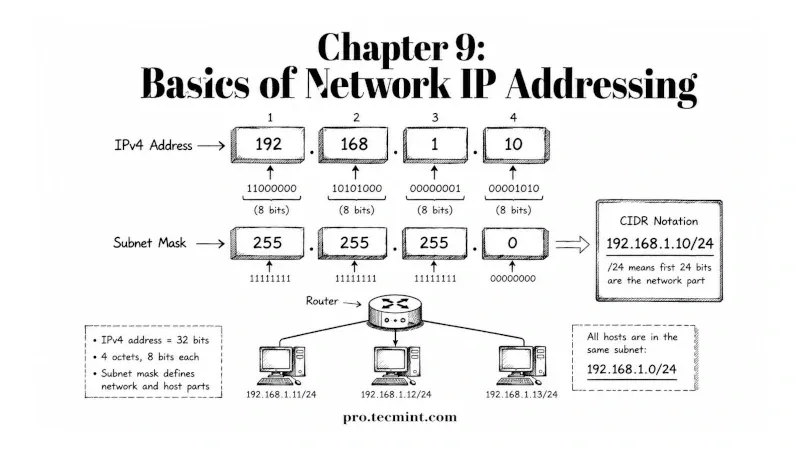
This chapter shifts from commands to concepts, covering network IP addressing; what an IP address actually is, how IPv4 addresses are structured, what subnet masks do, and how CIDR notation works.
How to identify a network address and broadcast address from a given IP and mask, and this is the theoretical foundation behind the ip addr, ip route, ping, and ss commands you've been using since Chapter 4.
The System Administration Fundamentals domain (30%) of the LFCA exam tests this material directly, and network addressing questions are consistently among the ones that candidates lose marks on because they skipped the theory and only practiced the commands.
So read this chapter carefully and work through the examples on paper or on screen as you go.
Every concept in this chapter applies to any modern Linux distribution, including Ubuntu, Debian, Fedora, Rocky Linux, and RHEL.