Chapter 14: Cloud Availability, Performance, and Scalability
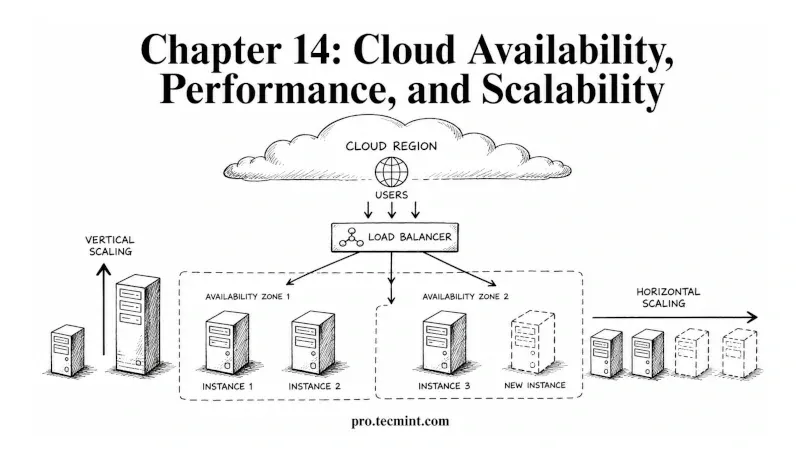
In this chapter, you'll learn how cloud providers design for high availability, what SLAs mean, how redundancy across availability zones works, and the difference between vertical and horizontal scaling.
In Chapter 13 of the LFCA Certification Course, you learned what the cloud actually is, how IaaS, PaaS, and SaaS differ in terms of customer and provider responsibility, the 4 deployment models, and the shared responsibility model that defines the security boundary between provider and customer.
This chapter covers how cloud providers design infrastructure to stay up, stay fast, and handle changing load, specifically high availability, performance, and scalability, and these are the properties that make the cloud a viable platform for production workloads rather than just a convenient place to rent servers.
The Cloud Computing Fundamentals domain (18%) of the LFCA exam tests these concepts both through direct definitions and through scenario-based questions where you're asked to identify the correct approach for a given availability or scaling requirement.
Every concept in this chapter applies regardless of which cloud provider or Linux distribution you use.