Chapter 23: CI/CD Pipeline Fundamentals
In this chapter, you'll learn how CI/CD pipelines are structured, what stages and jobs do, how artifacts flow between stages, and how to read and write basic pipeline YAML configuration.
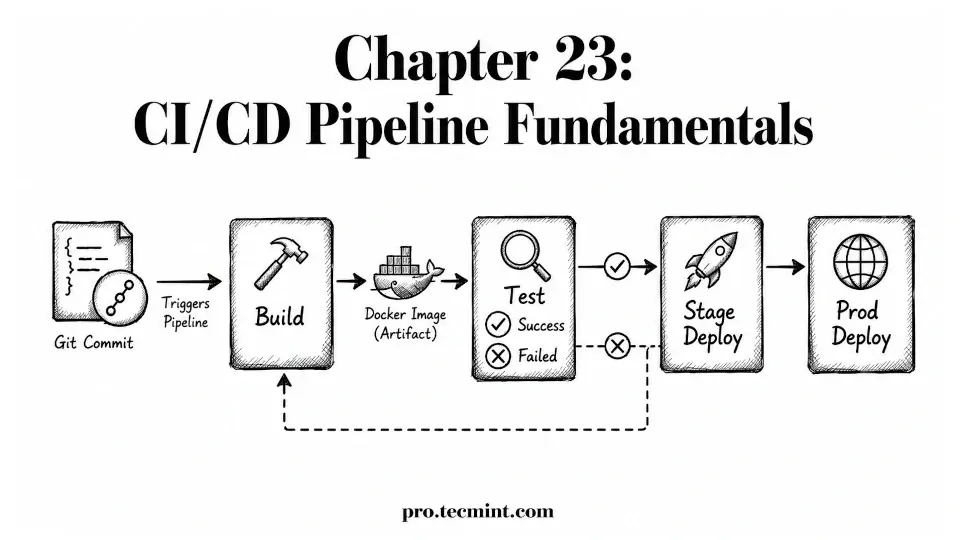
In Chapter 22, you learned how software moves through development, staging, and production environments.
You also explored how environment-specific settings are managed using environment variables and secrets management tools, and how deployment strategies such as blue-green and canary deployments help reduce risk when releasing changes to production.
In this chapter, you'll learn how CI/CD pipelines work behind the scenes. We'll look at how pipeline tools automate code movement between environments, how pipelines are organized into stages and jobs, what a pipeline configuration file looks like, how artifacts move between stages, and which events trigger pipelines to run.
This chapter builds directly on the CI/CD concepts introduced in Chapter 20 and the deployment environment workflow covered in Chapter 22.
For the LFCA exam, the DevOps Fundamentals domain (12%) expects you to understand the basics of CI/CD pipelines, including common pipeline tools, the purpose of different pipeline stages, how artifacts are used, and what happens when a stage fails.
This chapter covers these topics in a practical and beginner-friendly way, providing enough detail to help you answer related exam questions with confidence.
The concepts explained here are universal and apply regardless of the Linux distribution, cloud platform, or CI/CD tool being used.