Chapter #1: Introduction to Infrastructure as Code and OpenTofu
In this article, we'll explore Infrastructure as Code (IaC) and learn about using OpenTofu vs. Terraform for infrastructure management.
Welcome to the first chapter of our comprehensive OpenTofu series for beginners! Over the coming weeks, we'll take you from complete newcomer to confident Infrastructure as Code practitioner.
Whether you're a system administrator looking to automate your infrastructure or a developer wanting to understand how modern DevOps teams manage cloud resources, this series will give you the practical skills and knowledge you need.
This opening chapter lays the foundation by introducing you to Infrastructure as Code concepts and explaining why OpenTofu has emerged as a powerful, open-source solution for managing cloud infrastructure.
In this chapter, you'll learn:
- What Infrastructure as Code is and why it matters for modern DevOps teams.
- How OpenTofu differs from traditional infrastructure management.
- The story behind OpenTofu's creation and its relationship to Terraform.
- Why OpenTofu makes sense for managing cloud infrastructure at scale.
What is Infrastructure as Code (IaC)?
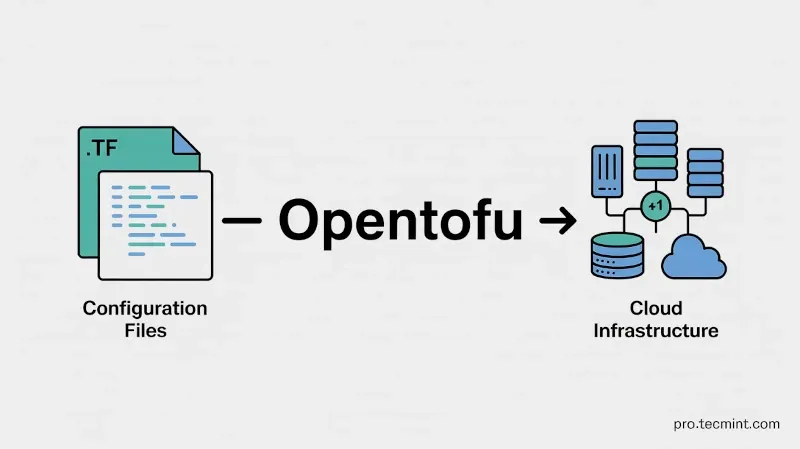
Infrastructure as Code is the process of defining computing resources through configuration files. Inside of these configuration files, we can declare values for servers, networks, storage arrays, and other hardware resources that we want to use in our infrastructure.
DevOps teams can then deploy these configurations to cloud providers, having the infrastructure spun up and configured according to the settings in the IaC files.
OpenTofu and Terraform are two IaC tools that engineers can use for writing and deploying these configurations. Both use the HashiCorp Configuration Language (HCL) for the definition files.
The code within these files is relatively straightforward and can be written by humans. The declarations and scripts inside the definition files will determine the overall configuration of the infrastructure.
Traditional Infrastructure Management vs. IaC
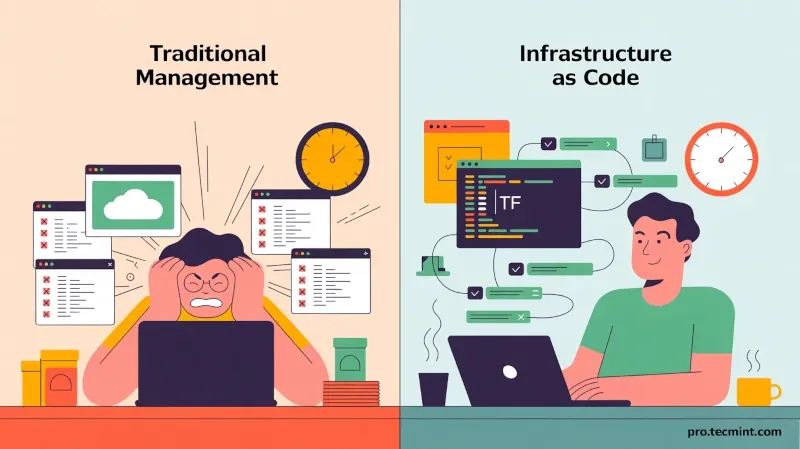
Traditional infrastructure management involves one or more system administrators manually setting up resources like virtual machines, networks, and software.
For a small infrastructure, there usually isn't any problem with this approach. However, for businesses that require a large and complex infrastructure, having to manually configure, deploy, and maintain every aspect of the data center is a time-consuming process that's prone to human error.
Infrastructure as Code tackles this problem by allowing engineers to specify all of the needed infrastructure settings in configuration files.
These files can be used any time that a new resource needs to be spun up, rather than having an administrator manually flip through a cloud control panel and tweak settings every time.
Not only does IaC save time, but it also reduces errors and makes deployment far more consistent.
For example, imagine you need to deploy 50 identical web servers across multiple regions. Traditionally, an admin would log into each cloud console, click through dozens of menus, and manually configure each server - a process taking hours or days.
With IaC, you write the configuration once, and OpenTofu deploys all 50 servers in minutes, each configured identically.
Furthermore, having all of the infrastructure defined in configuration files means that version control can help teams collaborate and keep track of every infrastructure modification.
And since OpenTofu and Terraform are cloud-agnostic (meaning that they will work with all major cloud providers), the IaC configuration can be ported to various cloud platforms.
IaC also allows for rapid deployment, meaning resources can be brought up or down on a whim to meet current demands.